OSFF London 2026: Platforms, AI and Open Source Are Converging

After a busy few weeks at OpenUK and PlatformCon, I headed back to London for the Open Source in Finance Forum (OSFF). I was particularly interested to hear how one of the world's most heavily regulated industries is thinking about two topics that have dominated almost every technology conversation this year: digital sovereignty and agentic AI.
What struck me wasn't any single announcement or new project. Instead, it was how quickly the conversation had shifted.
Last year, many discussions were still about whether AI would be adopted in financial services. This year, the assumption is that it will be. The questions are now about governance, security, operational resilience, and how platforms need to evolve to support it all safely. That aligns closely with the direction FINOS is taking across AI, cloud standards, interoperability and platform technologies.
Here are some of my takeaways.
Platforms are becoming a business strategy
The opening keynote from Broadcom made one thing very clear: platforms have become a board-level conversation.
The message wasn't about Kubernetes or developer tooling. It was about solving business problems.
Platform engineering was positioned as the foundation for:
Faster application delivery
Operational efficiency at scale
Cyber resilience
Supporting AI adoption
One observation I couldn't help but make, though, was just how overloaded the words "platform" and "orchestration" have become. Several projects introduced themselves as "platforms", despite solving very different problems. As our industry grows, we're going to have to become much more precise with our language.
Obviously, you know my stance on platform orchestration, as this is the core functionality of Syntasso Kratix Enterprise (SKE)!
Financial services are moving from AI experimentation to AI governance
If PlatformCon showed how excited the industry is about AI, OSFF showed what happens once organisations start deploying it in regulated environments.
Almost every AI discussion quickly turned towards governance. Not whether to use agents, but instead how to control them, how to audit them, how to understand what they did, and how to satisfy regulators. That feels like an important shift.
The financial sector doesn't have the luxury of deploying AI first and worrying about controls later. Governance has to be designed in from day one, which explains why executable standards, policy automation and deterministic workflows received so much attention throughout the event.
Security is becoming a race against time
One of my favourite talks came from Greg Kroah-Hartman on Linux in the Land of LLMs.
His message was refreshingly practical.
AI is helping attackers discover vulnerabilities faster than ever before. Fortunately, those same tools can also help defenders respond faster. The most memorable slide showed how dramatically the time between vulnerability disclosure and active exploitation has shrunk. What used to take months now happens in days.
His conclusion was wonderfully simple: "It's not magic, just do the work: find the bugs and fix the bugs."
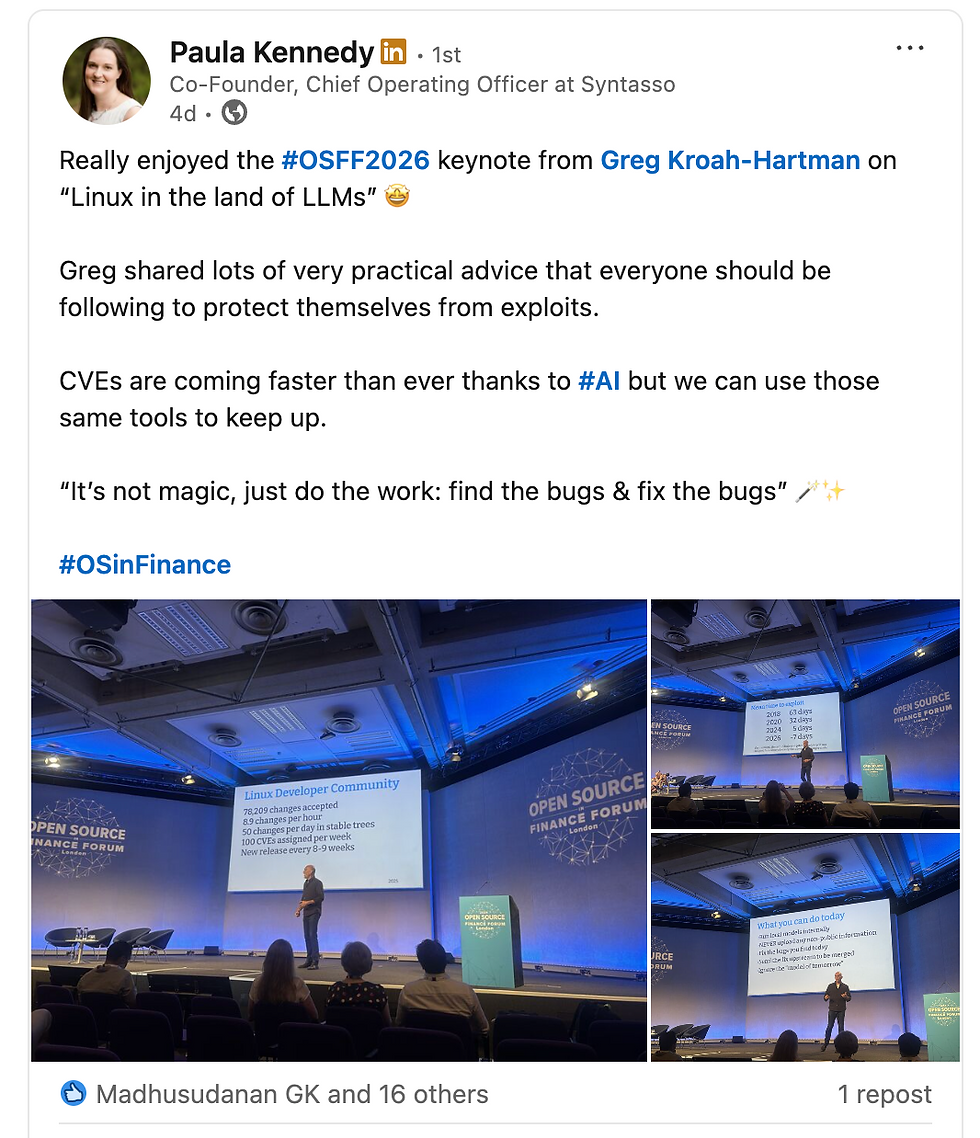
Sometimes the simplest advice is still the best.
Platforms are quietly becoming infrastructure for AI
One presentation that particularly caught my attention was Fluxnova, an open source BPM platform. Although still incubating within FINOS, its vision felt familiar. A central platform enabling self-service, standardised workflows, governance and extensibility.
It was interesting hearing organisations such as Deutsche Bank and Fidelity discussing production usage and the benefits of building around common workflows rather than bespoke integrations.
Whether it's called a platform, an orchestration engine, or a workflow system, the term almost becomes secondary. However, I would caution people experimenting with building platforms to avoid the "portals and pipelines" trap that we bump into.
The industry is clearly recognising that AI doesn't just need workflows. It needs APIs, lifecycle management, and well-governed operational systems sitting underneath.
Open source remains the industry's competitive advantage
One thing I always enjoy about FINOS events is the willingness of competitors to collaborate.
Banks that compete fiercely in the marketplace continue to work together on shared infrastructure, security standards and interoperability.
That collaboration becomes even more valuable as AI accelerates software delivery. No single organisation can solve governance, compliance, cloud standards or AI safety alone. Open source continues to provide the mechanism for solving common problems once and allowing everyone to benefit.
Leadership matters just as much as technology
One session that deliberately stepped away from technology focused on the Emerging FINOS Distinguished Engineer Community.
It sparked discussions around:
How experienced engineers can give back to the wider community
Supporting the next generation of technical leaders
Improving diversity within senior engineering roles
Building organisational structures that recognise different career paths and life circumstances
These conversations matter. The technology industry spends a lot of time talking about technical excellence, but sustaining healthy engineering organisations requires investing in people as much as platforms.

I'm looking forward to seeing how this community develops.
My biggest takeaway
Walking away from OSFF, I found myself thinking less about individual technologies and more about the direction the industry is heading.
AI is no longer a future capability, and open source is no longer simply about reducing software costs.
Platforms are also no longer just internal developer tooling. They're becoming the operational foundation that allows organisations to adopt AI safely, consistently and at enterprise scale.
For companies operating in regulated environments, that's likely to become one of the defining engineering challenges over the next few years.
And if OSFF was any indication, it's one the open source community is already working on together.


Comments