Platform Capability Factors: An Open Standard for Scaling Platform Contribution

Organisations demand capabilities that are operable and scalable across a range of disparate platform technologies. The architectural patterns that achieve this are not unique to a single organisation, Infrastructure as Code (IaC) tool, or user interface choice. What platform teams need is a clearer model for what a scalable capability looks like so that every new capability does not become another special case to integrate, govern, and operate.
That is the purpose of Platform Capability Factors. A set of global properties can be defined to enable capabilities to be built independently, integrated easily, and operated at scale. Those three properties matter because they describe what a coherent platform needs from its building blocks to sustain over time, not just the static upfront platform design diagram.
AI Doesn't Just Push Speed, It Pushes Boundaries
The proposed solution to so many software delivery challenges today is AI. Love it or loathe it, this is the world in which we all live. AI moves at such a pace and with such single-minded focus that it tramples through team boundaries that humans have long collaborated within and across.
AI is much less patient than humans. It doesn't want to wait for an internal process. Given the chance, it will happily use unsanctioned, possibly insecure, or untracked solutions to unblock itself. If a platform requires people to route every change through a central process, AI will immediately expose that weakness by bypassing it or working around it.
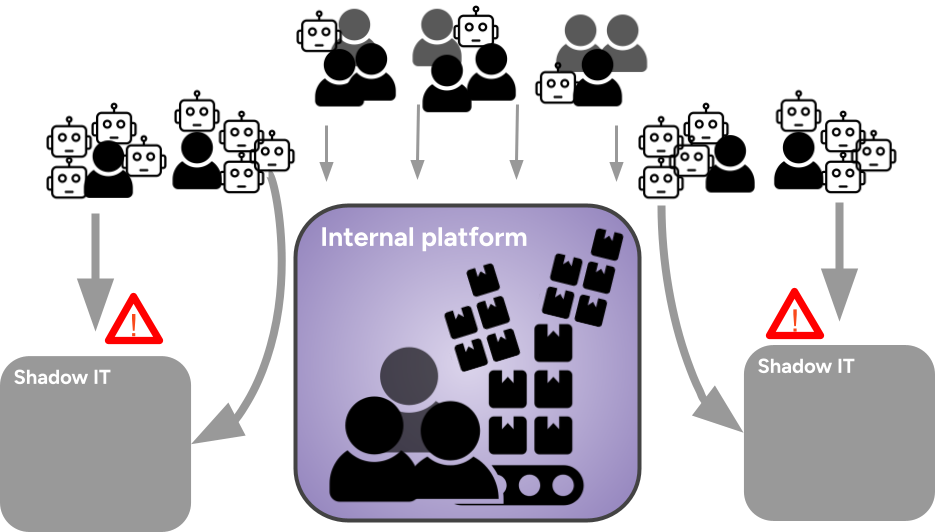
That does not mean AI changes the architectural principles. It means AI makes weak principles more expensive. In an era when agents work within our teams, clear team boundaries become even more important. Those who create software need to be able to depend on those who create infrastructure for fast, safe, and efficient delivery of compliant infrastructure.
Principles Drive Outcomes
Independent capability creation can scale platform growth by ensuring a valuable solution is delivered by a team that knows the problem domain best, in the right tools for the job, without delay due to centralised code or integration reviews and costs.
Beyond a single capability, composable platforms allow organisations to build higher-value solutions. Composition is only safe when capability providers can own their own flow of value end-to-end, encapsulating any prerequisite dependencies. A security scanning capability, a database capability, or a networking control should each be owned end-to-end by the specialists responsible for it.
Value can only be measured when organisations see a platform's end users deliver faster, safer, and more efficiently. Capabilities can encourage consumers to trust in adopting their offering by providing stable, versioned APIs. Consumers are particularly effective when they can focus on achieving outcomes from the capability and do not need to onboard to the tools, languages, or internal workflows that deliver it. If the contract is good, teams can compose capabilities together without having to negotiate each implementation detail every time.
And finally, since the lifetime cost of software is heavily weighted towards extension and maintenance after the initial release, creating sustainable scale demands that a capability is built with day-2 in mind. Composition into higher-level workflows and continuous reconciliation can be enabled by designing capability inputs and outputs as declarative outcomes. In practice, that means fleet management, observability, and a way to reconcile desired state with actual state over time. A capability should not become more fragile as adoption grows.
Taken together, these factors shift the conversation away from "how do we build this one thing?" and toward "how do we design capabilities so they can keep working as the platform grows?" That is the operational test that matters. Individually, none of these ideas are new, but together, they create a set of factors that define how capabilities can be developed autonomously without introducing coordination overhead.

This is where the practical payoff becomes clear. In return, platform providers reduce operational overhead by abstracting the underlying technology and enabling fleet management of any supported instances without user impact. They have access to observability and built-in governance to ensure compliance, traceability, and adaptability as organisational needs evolve and issues arise. Consumers benefit as well, as they gain self-service access with reduced operational load.
At its best, autonomy allows teams to adopt a true platform-as-a-product mindset, but without support, it can feel like a burden, leading to fragmented solutions. That is why the work matters now.
Guidance Can Nurture the Future, Rather Than Constrain It with Control
The lesson is not that organisations should centralise more tightly. Instead, it is that they need clearer, more explicit capability boundaries that let independent teams move quickly without losing coherence. That is what Platform Capability Factors are trying to capture: a common language for building independently without fragmenting the platform into incompatible parts.
As with any powerful movement, platform engineering has moved from a phase of unbounded hope towards a trough of disillusionment. This isn't a death sentence; it is a call to action to distil learnings from across the industry and ensure that organisations build with the best available information. The same questions keep appearing across organisations. Those are not niche questions. They are the shared problems of platform engineering.
The goal for the model is not to declare a final standard. It is to give the community a practical starting point. In this act of codifying a shared understanding, platform engineering can mature by achieving what every successful domain has needed: a common language, a set of expectations, and a way to safely build independently in a collaborative world.
We’re still early in this journey, and the ideas here aren’t finished. They are catalysts and starting points. The future of platform engineering is more than the low-level tools we choose to implement our platforms in. It is defined by the engineering practices used to design and deliver solutions that scale to the needs of our organisations and our users.


Comments